
When I first started in SEO, the steps were clear:
- Title tags and meta descriptions.
- Improve site architecture.
- Write content that answered a need that included keywords.
- Encourage outside sources to link to your page.
But the game has changed in the new AI world we are in.
Today, we’re optimizing not only for search engines but for systems that interpret, summarize, and respond to questions in ways we can’t wrap our heads around. It’s a shift that has left even seasoned SEOs asking:
How do I optimize for AI?
I’ve spent my career leading SEO strategy across enterprise organizations from GitHub, where I watched the birth of Copilot, to Adobe, where I currently work on the Technical SEO after being hired to fill in on the Insights team. My time includes working with data engineers, product teams, and analysts to diagnose how Google and AI systems interpret large amounts of data and content. And in between, I consult with clients under my SEOGoddess brand, helping them adapt to this new AI world we live in.
The questions I get from the people I work with at Adobe and my clients are all very similar. With all the information out there on AI Optimization, how do we really know what works and what doesn’t (remember llm.txt?)? It seems that SEOs are taking a hold of the AI optimization world and claiming they know how to get sites to rank, but these are the same SEOs that are using outdated strategies to optimize their clients (Note: If they mention “Domain Authority” then you know they aren’t credible SEOs). Not to mention that none of them agree on any of it. I mean, what are we calling this AI optimization thing anyways?
Let’s unpack what it means to optimize for AI search today, how it’s different from SEO, answering some of the most common questions and what it all looks like in practice.
How AI Is Changing Search
When GitHub was developing Copilot, I was able to get some insight into how large language models (LLMs) use training data. Copilot learns patterns from vast repositories of public code, interpreting context to suggest the next logical sequence… think of it as autocomplete on steroids.
Google’s AI Overviews, however, work differently. Instead of predicting the next word, they synthesize and summarize information from web pages to give a conversational answer as close to human as possible. Both systems rely on AI, but the core mechanics differ:
- Copilot generates predictive outputs based on learned syntax and intent.
- AI Overviews extract and summarize factual information sourced from the web.
When understanding how to optimize for the two models, it’s important to know the difference. Because Copilot doesn’t “crawl” the web, it learns from data it has already seen, optimizing for it means ensuring your public data, documentation, and entities are structured well, easy to understand and digest, and frequently updated. Google’s AI, on the other hand, pulls directly from live web results. For us as SEOs, this means content quality, technical integrity, and authority are more important than ever.
What Google Says About “Succeeding in AI Search”
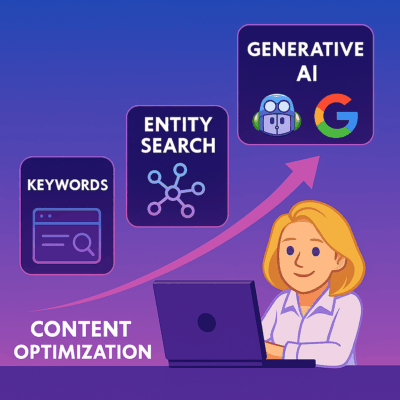
In its May 2025 Search Central blog post, Google made it very clear that optimizing for AI experiences isn’t a new playbook. It’s the same fundamentals that are just done better.
Here’s what stands out most:
- Unique content wins – Google’s AI is trained to identify pages that add something new… not just restate what’s already out there.
- Page experience still matters – The AI models behind Google Search reward speed, clarity, and accessibility.
- Structured data matters more than ever – Schema helps both search engines and LLMs interpret your content accurately.
- Measurement must evolve – Clicks aren’t the only indicator of success. It’s a matter of how often you’re referenced in summaries as more of a brand awareness play than a traffic play.
With both my clients and Adobe, I’ve worked extensively to help the folks I work with understand that it’s not how the pages rank, but how they’re surfaced within this new search experience. That means building dashboards in Power BI and Databricks to measure impressions, AI visibility, and downstream engagement metrics that reflect how users actually interact with content across search modes.
The shift to this new discovery has left even experienced marketers and SEOs feeling disoriented. On LinkedIn and Reddit, I see so many questions with even more confusing answers:
ou can see that uncertainty spilling into SEO forums and Reddit threads, where marketers are asking the same big questions that everyone in the industry is wrestling with right now.
What People Are Asking on Reddit
If you browse Reddit’s SEO threads, you’ll see the same five questions come up again and again… it’s just proof that even experienced SEOs are feeling the uncertainty. The rules that once defined success now feel blurry as AI changes how results are generated and measured.
Everyone’s searching for clarity in a system that’s still learning how to define itself.
I gathered a few of the questions I see the most and attempt to answer them for you here…
1. “How do you optimize for AI?”
The short answer: you don’t “game” AI. You help it understand you.
That means using rich content with markup that is structured well, and natural question/answer formatting so that AI models can easily parse what you are trying to say. I’ve helped clients achieve this by restructuring their FAQ sections (following Google’s new FAQ guidelines) and rewriting headings into clear sentence or question formats with use of TL;DRs, bullet lists links out to information supporting points and conclusions with citations.
2. “What are the best practices?”
The most effective AI search optimization comes from understanding intent. When I worked with one SaaS client, we built topic clusters around long-tail queries like “free invoice maker” and “timeline creator.” These pages were restructured with concise answers at the top, expanded guidance below and links to relevant content. The result? Higher visibility in both AI Overviews and People Also Ask results with traffic that was more qualified resulting in more revenue for the client.
3. “How do we measure AI visibility?”
When people ask how to measure success in AI search, what they really want is a way to see where the brand is cited, how often those citations happen, and whether any of that turns into growth. At Adobe I have had the priviledge to be a beta user of LLM Optimizer, and it pushed my thinking from “rankings” to a broader view of AI search optimization that connects visibility to business impact.
Tracking without LLM Optimizer looks something like this:
- Presence
Are we appearing inside AI overviews, chat answers, and agentic browsers for priority topics - Positioning
How are we referenced in those answers, which entities co-occur with our brand, which competitors appear alongside us - Performance
Do these exposures correlate with assisted conversions, brand lift, or downstream engagement even when clicks are zero
Should we call it the “Three Ps”?
It’s good to look at these three signals, but it’s a manual process to capture the data. Screenshots, spot checks, spreadsheets, and a lot of frustration when teams ask you to dive deeper into something.
Adobe’s LLM Optimizer takes the manual guesswork out of AI search optimization by automating the entire process for enterprise teams. It tracks where and how often your content appears across LLMs, measuring AI search share of voice, citations, and even which queries are triggered by AI agents. It assigns Generative Engine Optimization (GEO) scores to pages, reveals competitive gaps, and then goes a step further with prescriptive recommendations you can deploy instantly through Adobe Experience Manager Sites or connected CMS platforms. Built on secure frameworks like Agent2Agent (A2A) and Model Context Protocol (MCP), it enables one-click implementation within enterprise workflows. Most importantly, it closes the loop between visibility and revenue… quantifying how AI citations influence engagement, conversions, and projected traffic value… all backed by reports that are shareable turning complex data into actionable business insights.
4. “Is AI Optimization (or LLM Optimization or GEO) different from traditional SEO?”
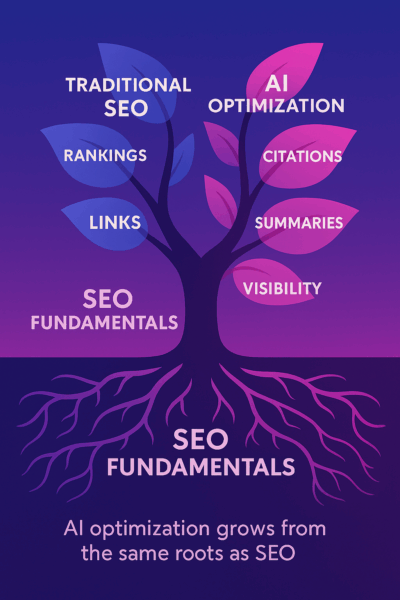
Well… yes and no. The technical foundations are the same, but AI introduces new layers of interpretation. You’re no longer just optimizing for indexation. You’re optimizing for comprehension.
At GitHub, when we trained documentation for Copilot, our goal was to ensure the model could understand context at both a code and semantic level. The same principle applies to AI optimization… structure your pages so an LLM can “grasp” the relationship between topics, steps, and entities.
5. “What’s working right now?”
Content. Content. Content:
- Credible and attributed (author or brand)
- Structured cleanly with H2/H3 hierarchy
- Supported by unique data, examples, or visuals
- Optimized for fast, frictionless experience
The proof is in the data. For one client in the construction equipment space, I optimized hundreds of “near me” pages with schema, unique copy, and local signals. Within three months, they saw a 40% lift in impressions and a rise in AI-generated local results referencing their listings.
The Vocabulary of AI Search Optimization
The industry can’t seem to agree on what to even call this new era of optimization. Every week, someone coins another acronym (AI SEO, GEO, LLMO, AEO) each trying to define how we adapt to a world where search is dying and the new kid is taking over. That confusion makes sense; we’re naming the plane while we’re still building it. Here’s how I break down the terminology when helping clients make sense of it all:
- AI Search Optimization: The overall practice of adapting SEO to perform well in AI driven search experiences like Gemini and AI Overviews in search results.
- Generative Engine Optimization (GEO): Ensuring your brand and content are referenced or cited in generative answers.
- Large Language Model Optimization (LLMO): Structuring your website so that AI models can understand, extract, and trust your content.
- Answer Engine Optimization (AEO): The precursor to GEO… focused on direct answers and/or FAQs.
Each concept connects back to a single goal: make your content understandable and worthy of a reference to both humans and machines, content that can be confidently cited, summarized, and trusted. I often describe this not as “search optimization,” but as research optimization. We are no longer just trying to appear in a list of links; we are influencing what people and AI systems learn during the research phase of the buyer journey. That is where credibility and clarity matter most. When your content is crafted to educate, to answer, and to provide context rather than to sell, it naturally becomes the material that LLMs select, surface, and build upon.

What AI Search Optimization Looks Like in Practice
In practice, AI optimization is not just a theory or a checklist; it is an ongoing process of testing, refining, and aligning content with how large language models interpret information. At Adobe, and in my client work, I focus on bridging data with storytelling… using analytics, structured signals, and clear narrative frameworks to ensure that both search engines and AI systems understand the depth, authority, and intent behind the content.
-
Make Content Citable
Write so that both a journalist and an AI model would want to quote you. That means concise answers, strong claims backed by data, and unique angles. When I updated GitHub’s marketing pages, I added definitions, glossary terms, and code examples formatted for snippet extraction. It made the pages “readable” to both search engines and AI.
-
Keep Technical SEO Tight
Whether you’re a big company or a startup, technical SEO is the scaffolding that AI depends on.
I’ve led projects fixing schema issues, canonical conflicts, and broken internal link structures that confused crawlers and degraded topical clarity. -
Design for Experience and Extraction
AI systems don’t “see” like humans, but they extract text the way a screen reader does. That’s why I emphasize clean heading hierarchies, minimal clutter, and visible answers above the “fold”. When I rebuilt a client’s product detail pages to match this model, we saw improved CTRs and AI snippet citation rates within a month.
-
Measure Beyond Clicks
Traffic reports are no longer enough.
Track “zero-click value” content that may be summarized in AI responses without a corresponding page visit but still boosts brand authority and recognition. For SEOGoddess clients, I teach teams how to use AI search optimization tools like SpyGPT to track brand mentions in AI summaries and compare them to traditional impressions. -
Build Topical Authority
AI models reward depth. That’s why I guide clients to expand content clusters with layers: definitions, use cases, tutorials, and FAQs.
When we structured a cluster for “meme generator,” the strategy went beyond one keyword… we created a sort of ecosystem of content: building trust with a nervous horse, trail obstacles for building confidence, best bits for soft communication, equine first aid essentials, understanding horse body language… The result was increased semantic association; content that not only ranked but was understood.
What to Avoid
Even seasoned teams that have mastered traditional SEO often stumble when adapting to AI search, struggling to translate familiar strategies into a world where algorithms summarize, interpret, and contextualize content rather than simply rank it.
- Don’t stuff with structured data use it meaningfully.
- Don’t create “AI-first” fluff content that lacks expertise.
- Don’t use AI to optimize for AI.
- Don’t measure success solely by rankings; measure visibility and influence.
- Don’t treat AI search optimization as a one-time setup. It’s ongoing.
I’ve been in SEO long enough to know that every evolution, from mobile-first indexing to Core Web Vitals, brings panic before perspective and AI search optimization is no different. It’s not replacing SEO, it’s revealing what great SEO was always meant to be: helpful, structured, and valuable to humans and systems alike.
The SEOs who will thrive are the ones who build bridges between technology and storytelling, analytics and empathy, data and intent.
If you’re ready to optimize your website for search in this new AI world we have been thrown into, start by tightening your fundamentals, understanding how AI sees your brand, and adopting tools that track both search and generative visibility.
Citation/Further Reading
Google. Top ways to ensure your content performs well in Google’s AI experiences on Search. May 21, 2025.
https://developers.google.com/search/blog/2025/05/succeeding-in-ai-search
Related Posts







The Story of the SavetheBreakfastSandwich.com Website
The Starbucks Breakfast Sandwich In January of 2008, I was gainfully employed with one of the many technology corporations based in Redmond, WA (No it wasn't Microsoft). It was Concur Technologies, [...]

SEO Checklist – Focusing on Social Media
As some of you know I teach a beginner to advanced SEO Workshop. One of the most asked for items in my talk is the SEO Checklist I have developed just [...]



Building a Social Media Community
The staff at Jenn Mathews Consulting use a system for social media marketing called the A.L.I.V.E. system. A majority of our clients have created their Facebook page and Twitter account, but [...]